Monday, 23 September 2013

Did the Mafia ever use Concrete Shoes?

Or concrete wellies, boots or overcoats for that matter? It is an image we're all familiar with from TV, films and books, but is there any truth in it?

The Last Shoes You’ll Ever Need


In episode 295 of The Simpsons, Fat Tony, the resident Mafia boss, is seen pouring cement into a bucket around the feet of a nervous looking man while a pair of goons observe.

Above Fat Tony’s head, a sign informs us that he is selling cement shoes, touted to be ‘the last shoes you’ll ever need’.

Season two, episode 17 of Star Trek: The Original Series, has an irate (when wasn’t he irate?) Scotty threatening a 1930s mobster with a pair of ‘concrete galoshes’.

Meanwhile, the 2006 short film featuring Dylan Moran, Tell it to the Fishes, involves a pair of gangsters, whose feet are encased in concrete, arguing on the beach at low tide.

Sleeping With the Fishes


If there’s a link between these depictions of the infamous ‘concrete wellies’, it’s the use of the image for entertainment purposes.

Nobody in The Sopranos was thrown off a bridge with their feet encased in concrete.

Likewise, The Godfather might have featured the line ‘sleeping with the fishes’ but Don Corleone never poured cement around his enemies’ feet, waiting a day for the mix to cure before taking a leisurely drive to the nearest pier and dumping them over the edge.

Mafia godfathers are business men (albeit with guns).  He’d never have allowed that sort of slack in the system!

Cement Overcoat


The entire premise of concrete shoes, or cement overcoats, arose after a couple of sensationalist stories printed in America in 1935.

There was talk of hits involving encasement in cement or, as in the Simpsons parody, someone standing in a tub of cement while it hardened so that they could be thrown into the sea.

No evidence of these murders was ever found, but that didn’t stop the idea spreading into popular culture, and in particular to the minds of writers of crime spoofs and parodies.

A Glimmer of Truth


Historically, there has long been a tradition of weighting down bodies, alive or dead, to ensure death or disposal.

In the age of sail, cannonballs were tied to the feet of deceased crew to ensure their bodies sank to the sea bed.

During the Reformation, Anabaptists were sewn into sacks with bricks and thrown into rivers or lakes.

Over the years, many bodies have been discovered weighted down in some way, with heavy chains or concrete blocks attached to them, including some Mafia hits, but never where the victim's body was in any way encased in the concrete itself.

Unless, of course, they do it so efficiently that the evidence has never surfaced (no pun intended!).

Nuisance Footprints


So, concrete wellies remain the stuff of fiction, for the most part.  But shoes and wet concrete are two things better kept apart as separating footwear and concrete can require specialist tools:


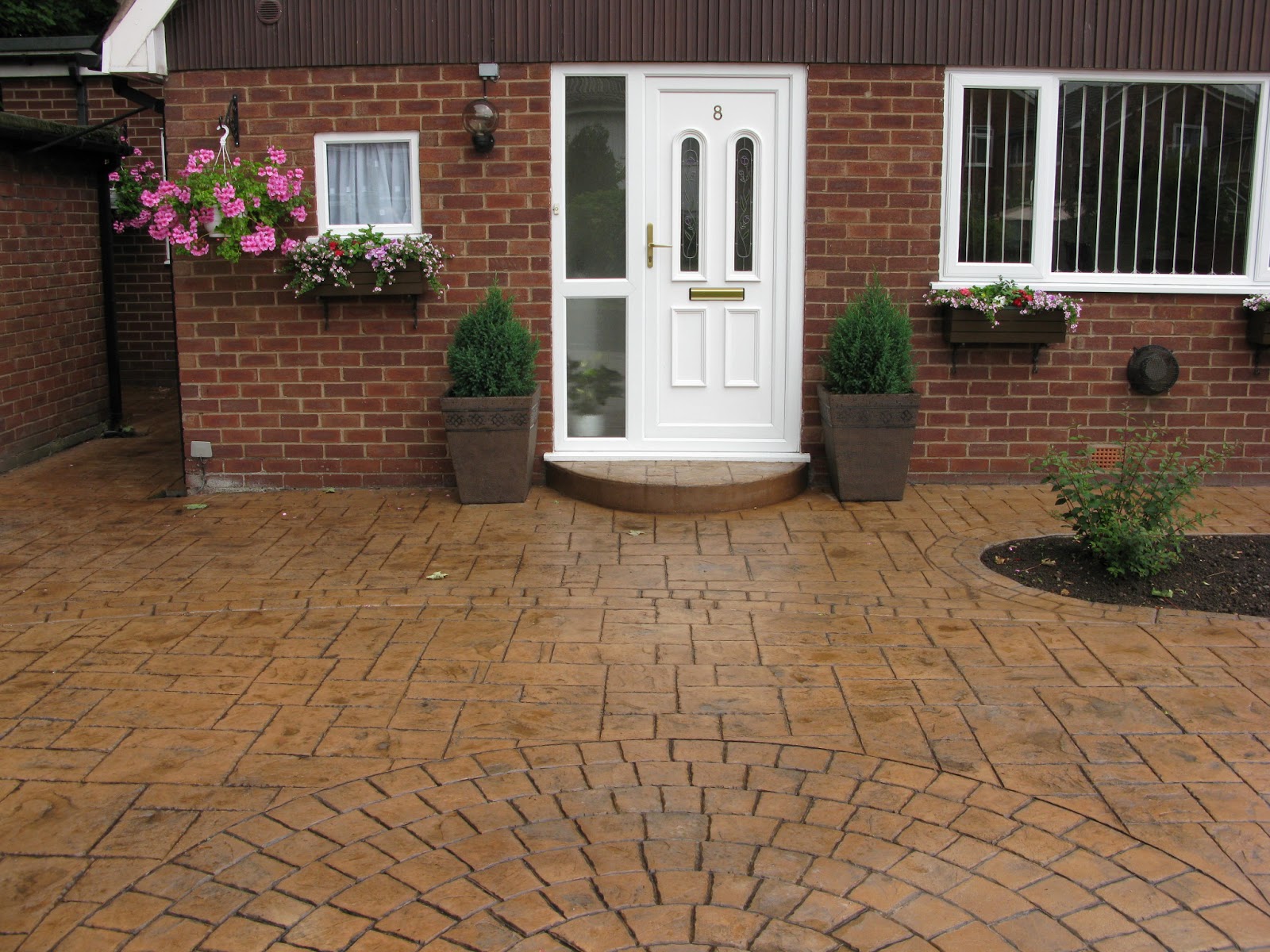
As you'd expect Northern Cobblestone are careful to ensure that driveways are protected whilst they set, giving you access to your property, but ensuring that the only imprints left are ones from our extensive range of styles and colours!

Concrete Driveways, Blackpool

The seaside resort of Blackpool in Lancashire is famous for many things, including Blackpool Tower, the Illuminations, Pleasure Beach and three piers overlooking it's expansive sandy beaches.

Perhaps lesser known, is that it is also right next door to Northern Cobblestone, specialists in pattern imprinted concrete based in neighbouring Poulton-le-Fylde.

Driveway Installers, Blackpool


With over 30 years paving experience, Northern Cobblestone have installed hundreds of miles of driveways, paths, patios and more in Blackpool and the wider North West.

Take a look below at a few recent examples:


If you live in the Blackpool area and would like an attractive low maintenance replacement for your tired old driveway, why not contact Northern Cobblestone for a quote?

More Photos


Take a look at the Driveways Blackpool page on our website for more examples of our stamped concrete installations.

Sunday, 22 September 2013

Origins of the Word Concrete


When we say the word concrete today, the first image that jumps to mind is probably that of the well-known rather solid construction material, but has that always been the case?

Well, that has been the most common English use of the word since the renaissance of concrete in the building industry in the late 19th century.

Prior to that however, the earliest English uses of the word concrete were far more likely to relate to the fields of alchemy, philosophy or chemistry.

You Say Concrete, I Say Concrētus


Like many words, concrete has its origins in Latin, the language of English academics since the French language infiltrated Anglo Saxon following the Norman invasion of 1066.

When it first turned up in written text, in 1471, it defined something which had grown together. In 1536, H Latimer described, in a written sermon, "A thing concrete, heaped up and made of all kinds of mischief."

This was a direct translation of the Latin con (together) and crēscere (grow) or rather the past participle concrētus (grown together).

Con appears frequently elsewhere in English with the same meaning of coming together. Think congregation, concoction, concur and conflict. Plus, it is the Italian word for "with". 

Concrete Facts


A hundred years on in the 17th century, academics started referring to things which were concrete to separate them from more abstract ideas.

Hence we have concrete numbers and concrete nouns.  In this instance, the word concrete refers to something real, something that can be observed, so a concrete number would be three stones or seven trowels rather than the abstract numbers 3 or 7, which aren’t counting anything you can see.

A concrete term also refers to something observable, so a fool is a concrete term but foolishness is not because you can’t see foolishness.

A Word of Substance


You might be forgiven for thinking that this latter use of concrete, as something that’s real and observable, is related to the rock hard material we use for our driveways.

After all, it’s heavy and there’s no denying its existence, as anyone who has dropped a bag of it on their toes will confirm.

But of course, concrete is an aggregate of various materials bonded together and therefore the literal Latin translation grown together applies.


In fact, the Romans used concrētus extensively as a building material (see Long Lasting Concrete). The name and the building material were simply lost to us and then re-discovered.

Regula Imprimitur Concretis


If the convoluted history of the English language is too confusing, the same can’t be said for Northern Cobblestone’s regula imprimitur concretis (or pattern imprinted concrete).

A simple coming together of style and technique, gracing properties across Lancashire and the North West!

Monday, 16 September 2013

Beware: Wet Concrete!

No, not freshly laid concrete, but rather a heralding of the coming Autumn and its associated weather front.

Yes folks, the weather in Lancashire and the rest of the UK has certainly changed from the lovely heatwave we were all enjoying.

Wet Look Concrete Driveway Photos


Given the awful weather, we thought why not upload a few that show how lovely pattern imprinted concrete can look when it's wet.

Take a look at these examples:


See, a pattern imprinted concrete driveway, path or patio from Northern Cobblestone will compliment your property, even after a rain storm!

Not Too Late!


If you like what you see and live in Blackpool, Preston, Lancaster or surrounding areas, there's still time to get yourself a lovely new driveway before the end of the year.

That way, it will be ready and waiting for next year's hoped for heatwave!

Tuesday, 16 July 2013

Driveway Installers, Preston

Operating in Preston, Lancashire and the wider North West area, Northern Cobblestone are driveway installers specialising in pattern imprinted concrete.

We believe in a quality finished product designed to suit your individual tastes and give your property a wow factor that will be the envy of your neighbours.

In addition to driveways, paths, patios, steps and other paving features, we also offer comprehensive drainage and hard landscaping services, meaning you'll only deal with one person from start to finish. No need to juggle several different contractors at once.

Please take a look at the installation below for a customer in the Chorley area, just south of Preston:


If you like what you see, please visit the Driveways Preston page on our main website for more information and to request a quote.

Friday, 12 July 2013

Meaning of Cracking the Flags

The sun is "cracking the flags" in the UK at the moment or more colloquially as we might say here in the North of England "it's crackin' t' flags out there". *

More commonly used in the North, the British phrase "cracking the flags" is used to refer to hot weather. The flags in questions are not the flapping variety, but rather flagstones i.e. paving slabs or stones.

The implication is that the heat from the sun is hot enough to crack stone. Indeed, in some locations, "cracking the stones" is also heard.

Searching on-line, some sites imply that the phrase is also used to refer to really heavy rainfall, although that isn't something we've ever come across.

Origins


As an everday phrase, it's origins are not clear and obvious appearances in popular culture are few, although you would be likely to hear it from a BBC North West Tonight weather presenter.

It does appear in a different context in Shakespeare's Measure for Measure as "if you be remembered, cracking the stones of the foresaid prunes", but we're fairly sure the two are totally unrelated.

A quick trawl of the internet though and we turned up the following song by a London based singer / songwriter named James Henry:


Although the song might lead you to conclude that the phrase is also common in the South of England, note that his Facebook page says he originates from Liverpool.

Flagstones vs Pattern Imprinted Concrete


As driveway installers with over 30 years experience, we can tell you that the weather in Britain is very unlikely to be hot enough to crack flagstones.

Indian stone, block paving, bricks and other driveway and path materials are susceptible to our cold weather extremes though and cracking from ice is commonplace following a harsh winter.

For this reason, we recommend and install pattern imprinted concrete, as it is fibre enmeshed and up to 25% harder than standard concrete.

When laid properly with the required expansion joints, it will last for many years and you can be assured that it won't be cracking from the sun, rain or frost.

* Note, for those not from the North of England, that the t' is more implied, than pronounced.

Tuesday, 30 April 2013

An Imposing Preston Driveway

© Copyright David Dixon and licensed for reuse
under this Creative Commons Licence
Following on from our previous Lancashire Driveway post, here's another imposing entrance, this time between Preston and Blackburn.

Like Stoneyhurst College, the length of Hoghton Tower's driveway is an impressive half a mile, although records indicate it used to be longer!

The Red Carpet Treatment


Having such a long driveway isn't always a good thing though. In 1617 king James I visited Hoghton Tower, at that time under the care of Baronet Richard Hoghton.

Although already burdened with financial difficulties, Richard was eager to impress the King and keep favour at court, so during the celebration the entire length of this vast driveway was carpeted in a luxurious red velvet.

It is reported that the extravagance of the royal visit nearly bankrupted the family, and indeed within a short space of time Richard Hoghton was jailed at Fleet Prison in relation to his debts.

The family prevailed however and went on to entertain many famous guests including The Duke of Edinburgh, Queen Mary and George V, William III, James I, Shakespeare, Dickens and Turner.

Pattern Imprinted Concrete Carpet


To get a feel for just how long half a mile is, take a look at this YouTube clip from the annual Hoghton Tower Bike Sprint, in which competitors race up the hill against the clock.


Now imagine that covered in red velvet. It'd probably have been cheaper to get red pattern imprinted concrete installed and certainly much longer lasting and easier to clean!

Perhaps if Wills and Kate visit, we'll call them with a price.

More Preston Driveways


If you live in the area and would like your more modest driveway, garden path or patio finished with stamped concrete, why not take a look at the Northern Cobblestone website for examples of our driveways in Preston and the surrounding area.

Mews cobblestone is more popular, but if you want us to try red velvet, just let us know!